
Skin Cancer Removal
Basal cell carcinoma (BCC) and squamous cell carcinoma (SCC) are the two most common forms of non-melanoma skin cancer. Both are strongly associated with cumulative sun exposure, making Australia one of the highest-incidence countries in the world. At YourSkin Clinic, our general practitioner provides assessment, biopsy, and surgical removal of BCC and SCC for eligible patients, with referral pathways in place where specialist input is required.
What Is BCC?
Basal cell carcinoma arises from the basal layer of the epidermis, most commonly in areas of long-term sun exposure such as the face, scalp, ears, neck, and hands. It often presents as a small, flesh-coloured or pearly-looking bump on the skin. It may bleed or have no symptoms, and can look like a pimple that doesn't fully heal Mayo Clinic Health System. BCC accounts for around 80% of non-melanoma skin cancers. UV radiation, particularly UVB, is a major risk factor, as it causes mutations in tumour suppressor genes. Other contributing factors include older age, fair skin, male sex, and immunosuppression nih.
While BCC very rarely spreads to other parts of the body, it's an invasive cancer. If left untreated, BCC can grow into surrounding tissue and cause significant local damage.
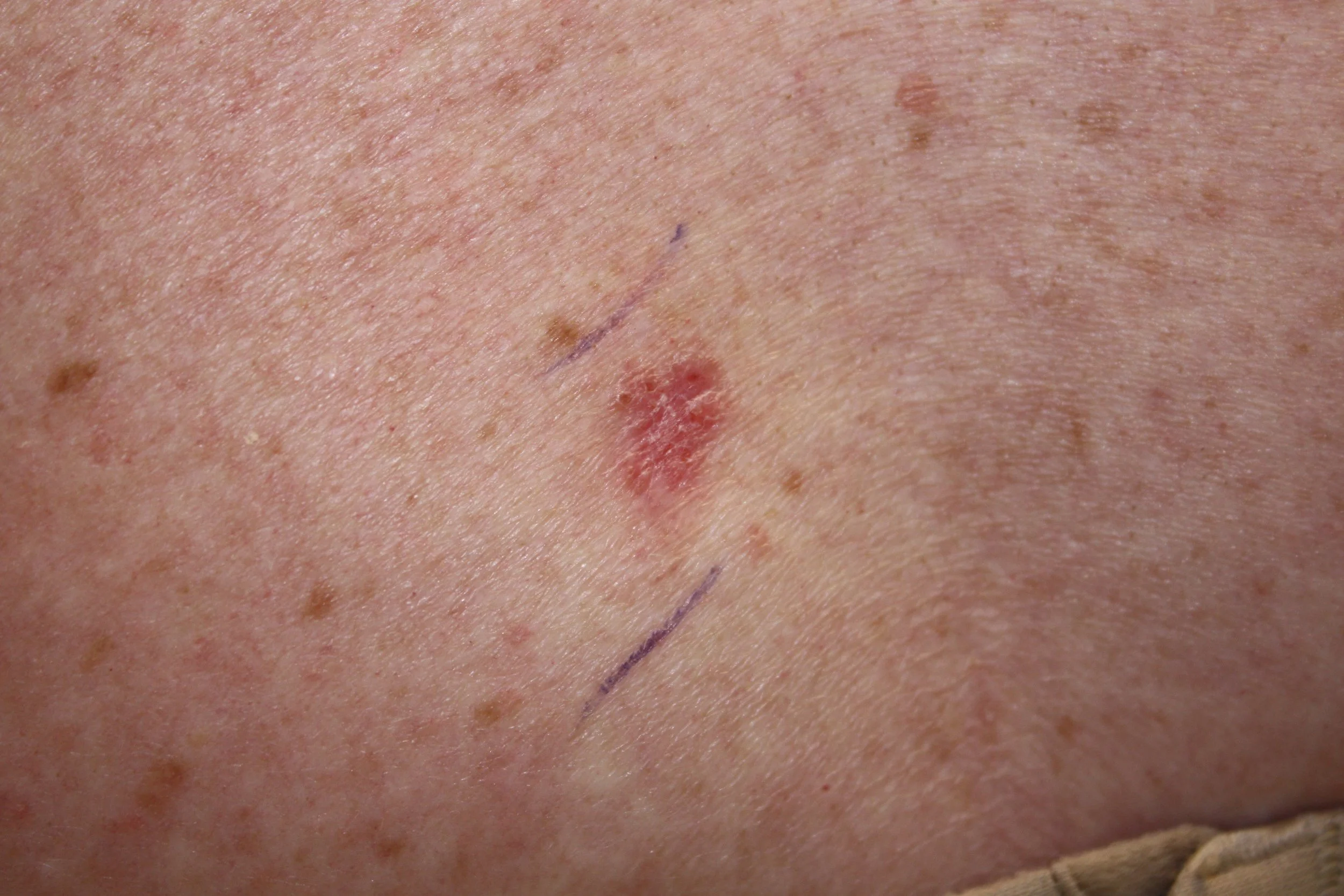
Credit: Kelly Nelson, M.D., (Photographer). Typical superficial basal cell carcinoma as a reddish-brown, slightly-raised lesion, with markings for biopsy
What is SCC?
Squamous cell carcinoma develops from the squamous cells of the outer layers of the skin. It can develop rapidly and may feel tender to touch. It typically appears as a rough or scaly patch or growth on the skin. SCC usually appears in one place and rarely spreads, but if left untreated, it may grow within the skin and affect surrounding nerves and muscles. In some cases, cancerous cells can spread to nearby lymph nodes. Mayo Clinic Health System
SCC is more likely than BCC to spread if not treated promptly, which is why early assessment matters.
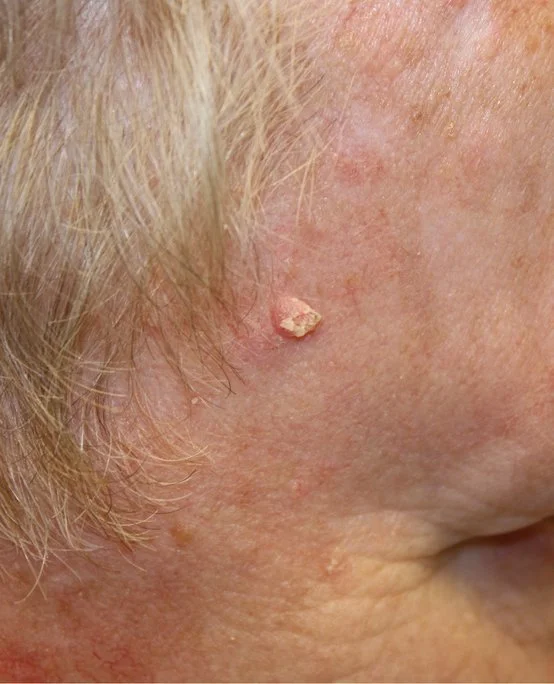
Credit: Kelly Nelson (Photographer), National Cancer Institute. A pink, raised lesion on the skin of the face. Squamous cell carcinoma.
How Are BCC and SCC Diagnosed?
Diagnosis typically involves two steps:
Clinical examination: your doctor will examine the area of concern and assess the rest of your skin for any other suspicious lesions. Your medical history, including sun exposure history, prior skin cancers, and family history, will be discussed.
Skin biopsy: a skin biopsy is used to remove a sample of tissue for testing in a laboratory. This determines whether skin cancer is present and identifies the type. The method used will depend on the type and size of the lesion Mayo Clinic.
If biopsy confirms BCC or SCC, your doctor will discuss the most appropriate treatment based on lesion size, location, and depth.
How Are BCC and SCC Treated?
Surgical excision
Surgical excision involves cutting out the cancerous lesion along with a surrounding margin of healthy skin. That margin is then examined under a microscope to confirm no cancer cells remain at the edges. Excision is one of the most widely used approaches for both BCC and SCC Mayo Clinic. Excision is often recommended for BCCs that are less likely to return, such as those on the chest, back, hands, and feet. For larger SCCs or those that extend deeper into the skin, a wider excision may be performed.
Curettage and Electrodessication
This treatment involves removing the top of the skin cancer with a scraping instrument (a curet), followed by use of an electric needle to sear the base of the cancer. This approach may be suitable for small, superficial lesions in lower-risk locations Mayo Clinic.
When Referral Is Needed
Some BCCs and SCCs are better managed by a specialist. Your doctor will refer you when:
The lesion is large, poorly defined, or located in a cosmetically or functionally sensitive area (such as the nose, eyelids, or ears).
There is concern about aggressive or recurrent disease.
The lesion may require Mohs micrographic surgery, which removes cancer layer by layer with real-time microscopic examination to minimise the removal of healthy tissue. This treatment requires multiple doctors to be involved.
The cancer has spread beyond the skin.
Risks of BCC and SCC Removal
All surgical procedures carry risk. Your doctor will discuss these with you before obtaining your consent. Common and possible risks include:
Scarring. All surgical excisions leave a scar. The extent varies depending on the size and location of the lesion and individual healing factors.
Infection. Any wound can become infected. Signs include increasing redness, warmth, swelling, or discharge. Prompt review is important if these develop.
Bleeding or bruising. Minor bleeding is normal. More significant bleeding is uncommon but possible, particularly in patients taking blood-thinning medications.
Wound dehiscence. In some cases, wound edges may separate during healing.
Nerve or vessel involvement. In certain locations, there is a small risk of temporary or permanent changes to sensation or, rarely, involvement of a blood vessel.
Incomplete excision. If cancer cells are found at the margin of the removed tissue, further surgery may be required.
Recurrence. Even after complete removal, there is a risk that a BCC or SCC may return, either at the original site or in a nearby area. Regular skin checks after treatment are important.
Anaesthetic reaction. Local anaesthetic is used for all excisions. Reactions are uncommon but can occur.
Frequently asked questions
-
Yes. General practitioners with appropriate training and experience perform surgical excision of BCC and SCC. Your doctor will assess each case individually and refer to a specialist where that is the appropriate course of action.
-
In many cases, yes. A biopsy is used to confirm the diagnosis before planning treatment. In some situations, the biopsy and excision may be combined in a single procedure. Your doctor will advise on the right approach for your lesion.
-
The procedure is performed under local anaesthetic, so you shouldn't feel pain during the excision. However, you can still feel non-painful stimulus such as pressure, vibrations, and possibly some tugging. There is also short discomfort during the anaesthetic injection and soreness around the wound site in the days following. Some patients may also feel dizziness from the stress of the procedure, however, we always do our best to make sure you are comfortable, safe, and relaxed.
-
All surgical excisions leave some degree of scarring. The final appearance depends on the size and location of the lesion and your skin's healing. Your doctor will discuss what to expect before the procedure.
-
This depends on the size and location of the lesion, but most straightforward excisions are completed within a long appointment.
-
Results are typically available within two weeks. We will contact you to discuss findings and further steps.
-
If pathology shows cancer cells at the edge of the removed tissue, further surgery will be discussed. This may involve re-excision or referral for Mohs surgery depending on the lesion type and location.
Disclaimer: This information is for general educational purposes and does not constitute individual medical advice. Always consult with a qualified health professional regarding your specific health needs.