
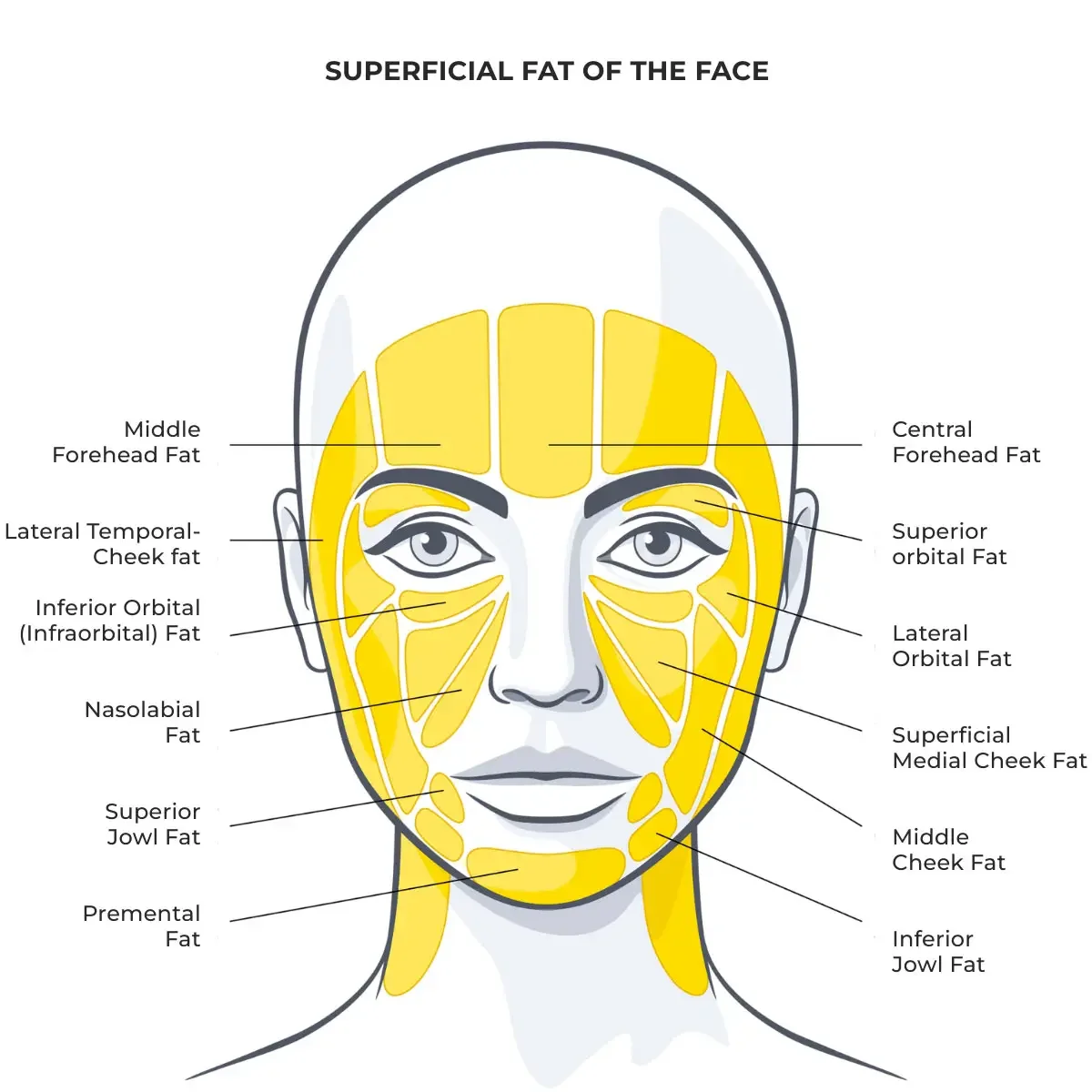
Facial volume refers to the fullness and three-dimensional structure of the face. It is determined by the underlying fat compartments, bone, muscle, and soft tissue. A young, healthy person’s face has well-distributed volume that provides lift, contour, and smooth transitions between facial features.
From our mid-twenties onwards, multiple age-related changes occur simultaneously:
Fat compartment changes: The face contains distinct fat pads that deflate and descend at different rates. Cheek fat pads, for example, begin to lose volume and shift downward relatively early.
Bone resorption: The facial skeleton - including the cheekbones, jaw, and orbit around the eye gradually recedes, reducing the structural scaffold that supports the overlying soft tissue.
Collagen and elastin decline: The skin becomes thinner and less able to retain its shape over a reduced scaffold.
Muscle changes: Some facial muscles thin with age; others may become relatively more prominent as surrounding structures deflate.
Facial volume
This material is intended for general educational purposes and is produced in accordance with the Therapeutic Goods Advertising Code 2021 (Cth). No specific therapeutic goods (including prescription medicines or medical devices) are named or promoted in this document. Treatment suitability is determined only after individual clinical assessment. YourSkin Clinic practitioners are registered with the Australian Health Practitioner Regulation Agency (AHPRA).
Treatments involving prescription medicines may only be recommended and supplied following a valid prescription issued by an authorised prescriber. Not all treatments described will be suitable for all individuals. Results are not guaranteed and vary between patients.
-
Volume loss is a universal component of facial ageing. It affects everyone to varying degrees. The rate and pattern of volume loss is influenced by:
Genetics: Facial ageing patterns run strongly in families
Starting volume: Individuals with naturally fuller faces may notice volume loss later in life; those with naturally slender faces may notice it earlier
Body weight changes: Significant weight loss (including after bariatric surgery or GLP-1 medications) can accelerate facial volume loss considerably
UV exposure history: Sun damage accelerates skin thinning and collagen loss, making volume changes more apparent
Smoking: Impairs collagen synthesis and microcirculation, accelerating tissue breakdown
Systemic health conditions and medications
-
Dermal fillers are injectable medical devices used to restore or augment facial volume, smooth folds, and enhance facial contours. The most widely used type contains hyaluronic acid (HA). HA is a sugar molecule that occurs naturally throughout the human body and is responsible for retaining moisture and providing structural support within the skin and connective tissue.
HA fillers are supplied in gel form and are injected beneath the skin using a fine needle or blunt-tipped cannula. They attract and bind water molecules, adding immediate volume at the injection site. The gel integrates with surrounding tissue and gradually breaks down naturally over time.
Dermal fillers are regulated as Class III medical devices by the Therapeutic Goods Administration (TGA) in Australia. They must be listed or registered on the Australian Register of Therapeutic Goods (ARTG) and may only be used by appropriately trained and qualified practitioners.
-
Dermal fillers can be used to address volume loss across multiple areas of the face. Common treatment areas include:
Temples: Restoring the lateral brow support and correcting hollowing that contributes to a tired or gaunt appearance
Cheeks and midface: Restoring height, projection, and fullness to the midface; one of the most impactful areas for overall facial rejuvenation
Under-eye / tear trough: Softening hollowing and shadowing beneath the eyes; a technically demanding area requiring careful patient selection
Nasolabial folds: Reducing the depth of the folds from the nose to the mouth, often improved indirectly by midface volume restoration
Lips: Restoring lost volume, definition, and shape to the lips and perioral area
Chin and jawline: Improving lower facial definition, symmetry, and proportion
Marionette lines and prejowl area: Softening the downward lines at the corners of the mouth and providing support to the lower face
Treatment suitability for each area is assessed individually at consultation.
-
A cannula is a thin, flexible tube with a blunt, rounded tip. In contrast to the sharp point of a standard needle. Cannulas are frequently used for filler placement in certain areas because they offer several advantages:
They can treat a wider area through fewer entry points
The blunt tip is less likely to pierce blood vessels, which may reduce the risk of bruising and vascular complications in appropriate technique hands
Many practitioners find them more comfortable for patients in certain areas
However, cannulas are not universally superior to needles. Both are valuable tools with specific indications. Sharp needles allow more precise, targeted placement in some areas. An experienced practitioner will select the most appropriate approach based on the treatment area, product, and individual anatomy.
-
Most patients describe the experience as mild to moderately uncomfortable. Several factors help minimise discomfort:
Topical anaesthetic cream is applied before treatment
The majority of filler formulations contain lidocaine, a local anaesthetic, within the gel itself
Ice packs are used before and after injection to reduce sensation and minimise swelling
Practitioners use fine-gauge needles or blunt cannulas where appropriate
Sensitivity varies between areas. The lips and perioral region tend to be more sensitive than the cheeks or temples. Anxiety and fatigue can also lower pain tolerance, so we encourage patients to attend their appointment well-rested.
-
Your initial doctor consultation is a thorough, no-pressure appointment lasting approximately 20-30 minutes. Our doctor will:
Take a full medical and skin history
Discuss your concerns, goals, and expectations in detail
Assess your skin and facial anatomy
Explain all relevant treatment options, including benefits, risks, and realistic outcomes
Review your current skincare routine
Take baseline clinical photographs (with your consent)
Guide you through the consent forms
There is absolutely no obligation to proceed with any treatment at the consultation. We encourage you to take time to consider your options.
-
Swelling: The most common and expected side effect; can be significant in the first 24 to 48 hours, particularly around the lips and under-eye area. Swelling typically resolves within 3 to 7 days.
Bruising: Common at injection sites; typically resolves within 5 to 10 days. The lip and perioral area is particularly prone to bruising.
Redness and tenderness: At injection sites; usually resolves within 24 to 48 hours.
Asymmetry: Differential swelling between sides can create temporary asymmetry. Always assess your result at 2 weeks when all swelling has resolved, not immediately after treatment.
Firmness or lumpiness: The filler can initially feel firm or uneven; this typically softens over 2 to 4 weeks as it integrates with surrounding tissue.
-
To support a comfortable treatment and minimise side effects:
Avoid alcohol for 24 hours before your appointment
Avoid aspirin, ibuprofen, fish oil supplements, high-dose vitamin E, and other blood-thinning agents for 48 to 72 hours beforehand. Only if it is safe for you to do so (do not stop prescribed medications without medical advice)
Arrive with clean skin, free of makeup
Avoid scheduling treatment within two weeks of a significant event. Swelling and bruising may take time to fully settle
Stay well hydrated in the days before treatment
Inform us of any recent illness, dental procedures, or changes in your health or medications since your consultation
-
Hyaluronic acid fillers are gradually broken down by the body's natural enzymatic processes. The longevity of results varies depending on several factors:
Filler formulation and volume: Denser, more robust formulations used in structural areas tend to last longer than softer products used in dynamic areas
Treatment area: Areas with less movement (cheeks, temples) generally retain filler longer than high-movement areas (lips, perioral)
Individual metabolism: Some patients metabolise filler more rapidly than others; exercise, heat, and overall metabolic rate can influence longevity
As a general guide, most patients find that results last:
Lips: 4 to 8 months
Nasolabial folds and marionette lines: 9 to 12 months
Cheeks and midface: 12 to 18 months
Temples and jawline: 12 to 24 months
Individual results vary. These timeframes are indicative only.
-
Following dermal filler treatment, please observe the following guidance:
Avoid touching, pressing, or massaging the treated areas for 6 hours post-treatment (unless instructed to by your clinician)
Avoid strenuous exercise, alcohol, and excessive heat (saunas, steam rooms, very hot showers) for 24 to 48 hours
Avoid significant sun exposure to treated areas for 2 weeks; apply SPF 50+ if outdoors
Sleep on your back if comfortable for the first night to avoid sustained pressure on treated areas
Avoid dental procedures for 2 weeks following lip or lower face filler treatment
A cool compress (not ice directly on skin) can be applied gently to reduce swelling in the first 24 hours
Avoid blood-thinning medications and supplements for 24 hours post-treatment if safe to do so
-
While serious complications from dermal fillers are rare, they can occur. Please contact our clinic immediately or seek urgent medical attention if you experience any of the following:
Skin colour changes at or near the injection site, such as blanching (white discolouration) or a blue-grey mottled appearance may indicate vascular compromise
Severe, worsening pain that is disproportionate to the procedure
Vision changes: blurring, double vision, partial or complete loss of vision: seek emergency medical care immediately (please call 000)
Stroke-like symptoms: weakness on one side, facial drooping, difficulty speaking: please call 000
Signs of infection: increasing redness, warmth, swelling, and pain beyond the first 48 hours; fever
Severe allergic reaction to hives, facial swelling, difficulty breathing: please call 000
Vascular occlusion (blockage of a blood vessel by filler) is a rare but serious complication that requires immediate treatment. Our clinic maintains hyaluronidase (the dissolving agent for HA fillers) on-site at all times. If you have any concern after hours, attend your nearest Emergency Department and inform staff of your recent filler treatment.
-
All medical procedures carry risk. For dermal filler treatments, risks are categorised as follows:
Common and expected (temporary): Bruising, swelling, redness, tenderness at injection sites; temporary asymmetry from differential swelling
Less common: Prolonged swelling or bruising; lumpiness or uneven texture; infection (rare with appropriate technique and aftercare); hypersensitivity reactions; migration of product from the intended area
Rare but serious: Vascular occlusion (filler entering or compressing a blood vessel, potentially causing skin necrosis or, very rarely, blindness if affecting the ophthalmic artery); delayed inflammatory reactions or nodule formation; nerve injury
These risks are discussed in full at consultation and are detailed in the consent documentation provided before any treatment. You will have adequate time to read and ask questions about the consent form before signing.
The risk of serious complications is significantly reduced when treatment is performed by a clinician with thorough anatomical training, appropriate qualifications, and access to emergency management agents including hyaluronidase. Always verify your practitioner's qualifications and AHPRA registration before proceeding.
-
Hyaluronic acid fillers can be dissolved using hyaluronidase, an enzyme that breaks down hyaluronic acid. This is an important safety advantage of HA-based products. Hyaluronidase is used in emergency context. If vascular occlusion is suspected, hyaluronidase can be injected immediately and in high volumes to dissolve the filler and restore blood flow. This is a time-critical procedure
Non-HA fillers (such as those based on calcium hydroxyapatite or poly-L-lactic acid) cannot be dissolved with hyaluronidase. This is an important consideration when selecting a filler type. We will discuss product selection at your consultation.