
Lines and Wrinkles
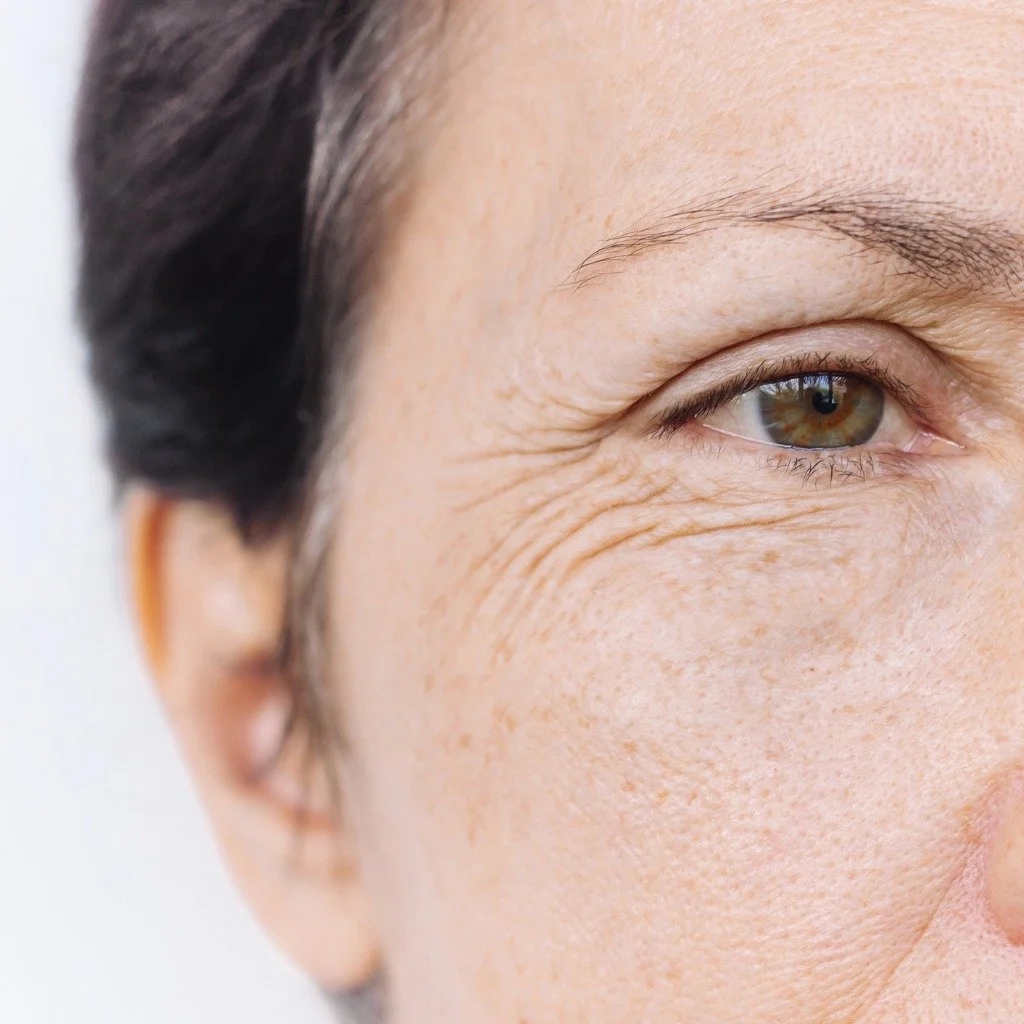
Lines and wrinkles are creases, folds, or ridges in the skin that develop naturally as part of the ageing process. They are among the most universal aspects of human ageing and affect everyone to varying degrees over time.
-
Wrinkling is caused by a combination of intrinsic (internal) and extrinsic (external) factors. These processes often interact and accelerate one another.
Intrinsic Ageing (Chronological)
This is the natural, genetically programmed ageing of the skin that occurs regardless of lifestyle. From approximately the mid-twenties onwards:
Collagen production declines by roughly 1% per year; collagen fibres also become disorganised and less resilient
Elastin fibres degrade, reducing the skin's ability to spring back after movement or stretching
Hyaluronic acid (a naturally occurring molecule that binds water in the skin) decreases, reducing hydration and plumpness
Sebaceous (oil) gland activity slows, making skin drier and less supple
Cell turnover slows, meaning dead skin cells accumulate and the skin surface becomes duller and less smooth
Facial fat pads reduce and shift position, causing hollowing and loss of structural support
Bone resorption occurs in the facial skeleton with age, reducing the scaffold that supports overlying soft tissue
Extrinsic Ageing
External factors that accelerate and worsen the ageing process:
Ultraviolet (UV) radiation: by far the most significant external cause; UV damages collagen, elastin, and DNA in skin cells; responsible for the majority of visible facial ageing (photoageing)
Smoking: impairs blood supply to the skin, accelerates collagen breakdown, and causes repeated lip pursing; smokers show significantly more wrinkling than non-smokers of the same age
Alcohol: dehydrates skin, depletes nutrients important for collagen synthesis, and causes chronic vascular changes
Poor nutrition: deficiencies in vitamins C, E, and A, and inadequate protein intake impair collagen production and skin repair
Repeated facial movement: contributes to dynamic line formation over time
Pollution: particulate matter and free radicals accelerate oxidative skin damage
Chronic stress: elevates cortisol, which breaks down collagen and impairs skin repair
Insufficient sleep: impairs nightly skin cell repair processes
Dehydration: chronically dry skin is more prone to fine line formation
Genetic Factors
Genetics influence skin thickness, pigmentation, oil production, and the rate of collagen loss. People with fairer skin and thinner skin tend to show wrinkling earlier, while individuals with more melanin have some additional protection against UV-induced photo-ageing.
-
Various grading scales exist (such as the Fitzpatrick Wrinkle Scale and Glogau Photo-ageing Classification) to standardise assessment and guide treatment planning. No investigation or blood testing is needed for cosmetic wrinkling assessment.
-
Treatment should be matched to the type and cause of wrinkling. Many people benefit from a combination of approaches. No treatment permanently stops the ageing process, and all require maintenance over time.
Retinoids (Vitamin A Derivatives):
The most evidence-based topical treatment for wrinkling. Retinoids increase cell turnover, stimulate collagen production, and improve skin texture and tone.
Prescription tretinoin (retinoic acid) has the strongest evidence base.
Over-the-counter retinol is weaker (must be converted by the skin to retinoic acid) but effective with consistent long-term use
Results take 3 to 6 months of consistent use to become apparent
Side effects include dryness, redness, and peeling, particularly when starting; begin with low concentration and increase gradually
Retinoids must be used with daily sunscreen as they increase sun sensitivity
Not suitable during pregnancy
Sunscreen:
Not typically considered a "treatment" but daily broad-spectrum SPF 30 or higher is the single most important step in preventing further photo-ageing and is considered standard of care by dermatologists. Evidence from long-term studies confirms that consistent sunscreen users show measurably less wrinkling over time than non-users.
Injectables:
How it works: A purified form of botulinum toxin is injected into specific facial muscles, temporarily blocking the nerve signals that cause muscle contraction. The overlying skin smooths as the muscle relaxes.
Medical-grade chemical peels:
Resurfaces the skin to address fine lines, pigmentation, and texture.
Dermal fillers:
Restores lost volume, softens deep folds (nasolabial, marionette lines), and provides structural support
-
The treatment you may receive is a purified protein that temporarily blocks the nerve signals responsible for muscle contraction. When injected in precise amounts into targeted facial muscles, it causes those muscles to relax. As a result, the appearance of dynamic lines caused by repetitive expression are reduced.
Results typically take 3-7 days to appear, with full effect visible at around 2 weeks. The results last on average 3–4 months, though this varies between individuals and with subsequent treatments. Some patients find results last longer over time with repeated treatment, as the habit of over-using certain muscles reduces.
Wrinkle injections are prescription-only medicines in Australia. They must be prescribed and administered by qualified healthcare practitioners.
-
Dermal fillers and wrinkle injections work via different mechanisms and are often complementary rather than interchangeable:
Wrinkle injections relax muscles to prevent dynamic movement causing lines. They do not add volume.
Dermal fillers are gel-like substances (most commonly hyaluronic acid) injected beneath the skin to restore lost volume, smooth static folds, and provide structural support. They are not muscle relaxants.
HA is a naturally occurring sugar in the body. The results from fillers are immediate and typically last 9–18 months depending on the product used, area treated, and individual metabolism.
-
Your initial doctor consultation is a thorough, no-pressure appointment lasting approximately 20-30 minutes. Our doctor will:
Take a full medical and skin history
Discuss your concerns, goals, and expectations in detail
Assess your skin and facial anatomy
Explain all relevant treatment options, including benefits, risks, and realistic outcomes
Review your current skincare routine
Take baseline clinical photographs (with your consent)
Guide you through the consent forms
There is absolutely no obligation to proceed with any treatment at the consultation. We encourage you to take time to consider your options.
-
Comfort levels vary between treatments and individuals. Most patients describe injectable treatments as mild to moderately uncomfortable rather than painful. We take several steps to minimise discomfort:
Topical anaesthetic cream is applied prior to many treatments
Many dermal fillers contain lidocaine (a local anaesthetic) within the formulation
Ice packs are used before and after treatment to reduce sensation and swelling
Our clinicians use fine-gauge needles and experienced technique to minimise discomfort
-
Treatment times vary by procedure:
Anti-wrinkle injections: 15 to 20 minutes. Results visible in 3 to 7 days, full effect at 2 weeks.
Dermal fillers: 30 to 60 minutes depending on areas treated. Results immediate, though some initial swelling may temporarily exaggerate the effect.
Profhilo / skin boosters: 20 to 30 minutes. Skin quality improvement noticeable from 4 weeks, best results after a course of 2 sessions.
Retinoid skincare: Consistent use for 12 weeks before assessing results; benefits compound over months and year
-
All treatments offered at YourSkin Clinic are clinically validated and delivered by trained, registered healthcare professionals. When performed correctly by a qualified practitioner, these treatments carry a favourable safety profile. However, all medical procedures carry some degree of risk.
Common and expected side effects (usually temporary):
Redness, swelling, and tenderness at treatment sites
Bruising (most common with injectables)
Temporary asymmetry as swelling resolves
Less common risks (which we will discuss fully at consultation):
Infection
Allergic reaction
Haematoma (collection of blood under skin)
Temporary headache following anti-wrinkle injections
Asymmetry or suboptimal aesthetic result
-
Certain conditions may make specific treatments inappropriate. Contraindications include:
Pregnancy or breastfeeding: most injectable and resurfacing treatments are contraindicated
Active skin infection or inflammation in or near the treatment area
Autoimmune conditions affecting the skin or connective tissue
Known allergy to treatment components (e.g. egg allergy may be relevant for some PDRN products)
Bleeding disorders or anticoagulant medication (increases bruising risk; requires medical review)
Certain neurological conditions (relevant to botulinum toxin)
Active cancer or history of keloid scarring (for some treatments)
A thorough medical history is taken at consultation to assess your individual suitability. We will never proceed with treatment if there is any doubt about your safety.
-
The vast majority of aesthetic treatments (including anti-wrinkle injections, dermal fillers, chemical peels, microneedling, laser, and most prescription skincare including retinoids) are contraindicated during pregnancy and breastfeeding. This is due to insufficient safety data and the pre-cautionary principle.
If you are pregnant, trying to conceive, or breastfeeding, please inform us at the time of booking or consultation. We will always prioritise your safety and that of your baby, and will be happy to discuss treatment planning for after this period has passed.
-
Following anti-wrinkle injections:
Remain upright for 4 hours post-treatment
Avoid touching, rubbing, or applying pressure to the treated areas
Avoid strenuous exercise, alcohol, and excessive heat (saunas, hot baths) for 24 hours
Do not wear tight-fitting headwear (hats, headbands) for 4 hours
You may apply a cool compress gently to reduce any swelling
Following dermal fillers:
Avoid pressure on treated areas for 24–48 hours
Avoid blood-thinning supplements (omega-3, vitamin E, aspirin if not medically required) to minimise bruising
Arnica gel or tablets may help reduce bruising
Avoid extremes of temperature and vigorous exercise for 24 hours
Avoid dental procedures within 2 weeks of lip or perioral filler treatments
-
Bruising is a common and temporary side effect of injectable treatments, particularly dermal fillers. To minimise and manage bruising:
Before treatment: Avoid blood thinners (aspirin, ibuprofen, fish oils, vitamin E, alcohol) for 48-72 hours if medically safe to do so.
After treatment: Apply a cool (not ice cold) compress. Never apply ice directly to skin.
Avoid: Heat, vigorous exercise, and alcohol for 24 hours.
Bruising typically resolves within 5-10 days. Colour-correcting makeup (peach or orange-toned) can conceal bruising while it fades.
If you experience severe, rapidly spreading bruising, significant pain, skin colour changes (white or blue patches), or vision changes after filler treatment, contact us immediately - these may be signs of a serious complication requiring urgent care.